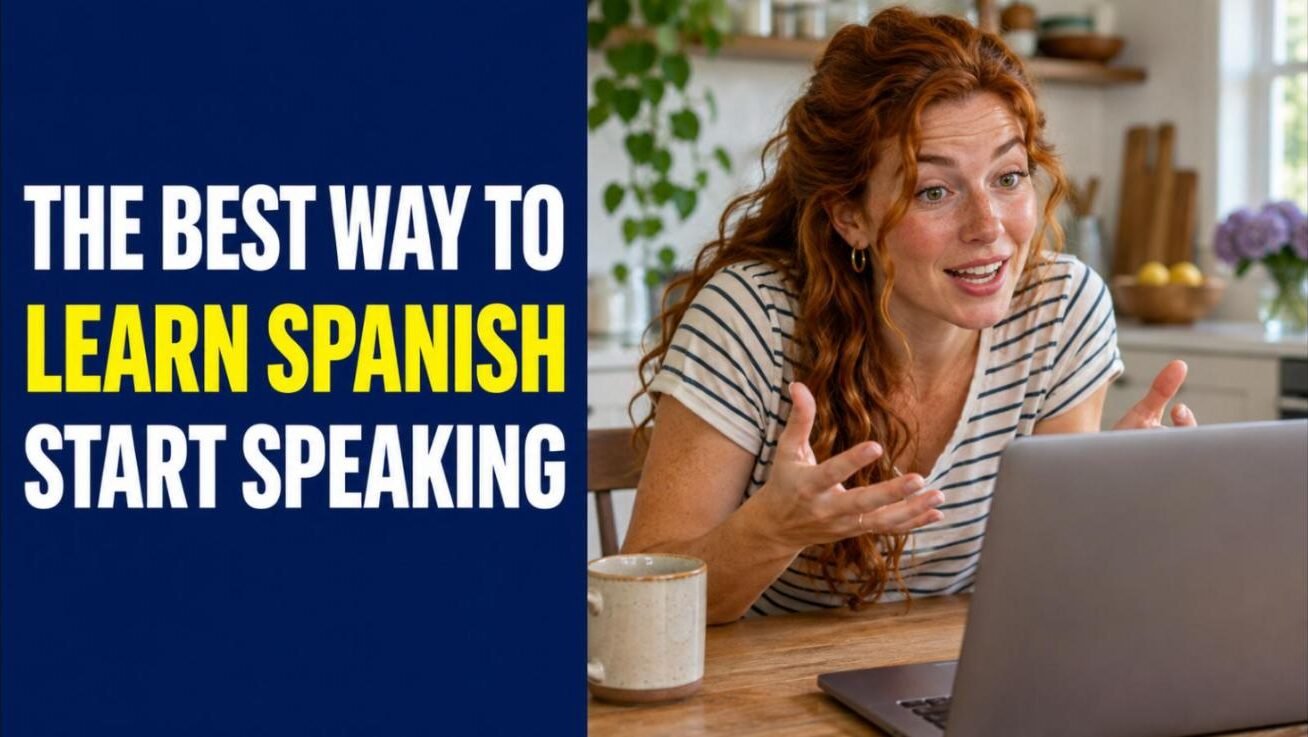
The Best Way to Learn Spanish Isn’t the One Most People Pick
This post contains affiliate links. As an Amazon Associate I earn from qualifying purchases, and I may earn a commission on other links, at no extra cost to you. Read the full disclosure.
Most people start learning Spanish by downloading an app. A year later they have a 300-day streak and can’t order lunch.
The app isn’t the problem. The problem is that tapping the right answer and saying a sentence to another human are different skills, and only one of them is the reason you wanted to learn Spanish. The best way to learn is whichever one gets you speaking earliest and most often. Everything else is a supporting act.
Five ways to learn Spanish, compared
| Method | Cost | What it’s good at | Where it falls short | Where to start |
|---|---|---|---|---|
| Gamified apps | Free to low | Building a daily habit and basic vocabulary | Very little real speaking | Try Duolingo |
| Group classes | Medium to high | Structure and a teacher to ask | You speak for a few minutes per session | Local schools and colleges |
| One-on-one tutor | Per lesson | The most speaking time and instant correction | Adds up if you go often | Find a tutor on italki |
| Immersion or travel | High | Forces you to use what you know | Hard to arrange, and you can still hide in English | Phrasebook on Amazon |
| Self-study built around speaking | Free to low | Daily output on your schedule | You have to supply the discipline | Grammar workbook on Amazon |
My pick is the last row, with a tutor or exchange partner added once you can hold a two-minute conversation. It costs the least, it fits around a job, and it puts the hard part (opening your mouth) first.
Why speaking has to come first
You get good at what you practice. Read Spanish and you’ll read Spanish. Match pictures to words and you’ll be excellent at matching pictures to words. None of it transfers to conversation as well as you’d hope, because conversation is fast, it’s out loud, and nobody shows you four options to choose from.
Speaking early also fixes the problem that stops most adult learners, which is fear. The first hundred sentences you say will be clumsy. Better to get them out of the way in week one, in your kitchen, than to save them up for a restaurant in Mexico City. I walk through that first week in how to speak Spanish from day one.
The daily mix that works
You need three things every day, and thirty minutes covers all of them.
Ten minutes of listening you mostly understand. Slow Spanish podcasts, beginner story videos, a show you’ve already seen dubbed into Spanish. If you catch about three quarters of it, it’s the right level. This is where new words and natural phrasing come from.
Ten minutes of speaking out loud. Shadow a short clip sentence by sentence, then describe your day in the simplest Spanish you can manage. No partner needed. There’s a full set of solo exercises in how to practice speaking without a partner.
Ten minutes of review. Go back over the words and phrases that tripped you up yesterday. Flashcards are fine for this as long as you say each one aloud. A physical deck like this Spanish vocabulary flash card set on Amazon keeps you off your phone while you do it.
Then, once or twice a week, talk to a person. A tutor, a language exchange partner, a patient coworker. That’s where you find out what you can really do.
Where apps, books and courses fit
None of them are bad. They’re just not the main event. An app is a good way to fill five spare minutes and keep a streak alive. A grammar workbook is worth having for the day you finally want to know why it’s “estoy” and not “soy” (Practice Makes Perfect: Complete Spanish Grammar on Amazon is a widely used one).
A structured course makes sense if you don’t want to plan your own practice. If you go that route, choose one that makes you talk. Better Language Learning is a speaking-first course built around short daily sessions, and it’s the one I link to on this site.
Four mistakes that slow people down
Waiting until you feel ready. You won’t, so start anyway. Studying grammar before you can say anything, which is like reading the rulebook before you’ve seen the game. Measuring progress by streaks and levels instead of by how long you can keep a conversation going. And switching methods every two weeks because the last one felt slow. They all feel slow. Pick a routine and give it ninety days. There are more of these in common mistakes to avoid when learning a language.
Keep going with the easiest languages to learn, how to say hello in Spanish, and ser vs estar.
Frequently asked questions
What is the fastest way to learn Spanish?
Daily speaking practice combined with listening you can mostly understand. Thirty focused minutes a day, plus one or two real conversations a week, moves faster than long weekend sessions.
Can I learn Spanish with just an app?
You can learn vocabulary and basic grammar. Most people need something more to become conversational, because apps give you very little practice producing sentences out loud.
Is it better to take a class or hire a tutor?
For speaking, a tutor. In a one-on-one lesson you talk for most of the session. In a class of ten, you might talk for five minutes.
Do I need to live abroad to become fluent?
No. Immersion helps because it forces you to speak, and you can create most of that pressure at home with daily speaking practice and regular conversations.
How long until I can have a conversation?
With consistent daily practice, most learners can handle simple exchanges within a couple of months. More on that in how long it takes to learn a new language.