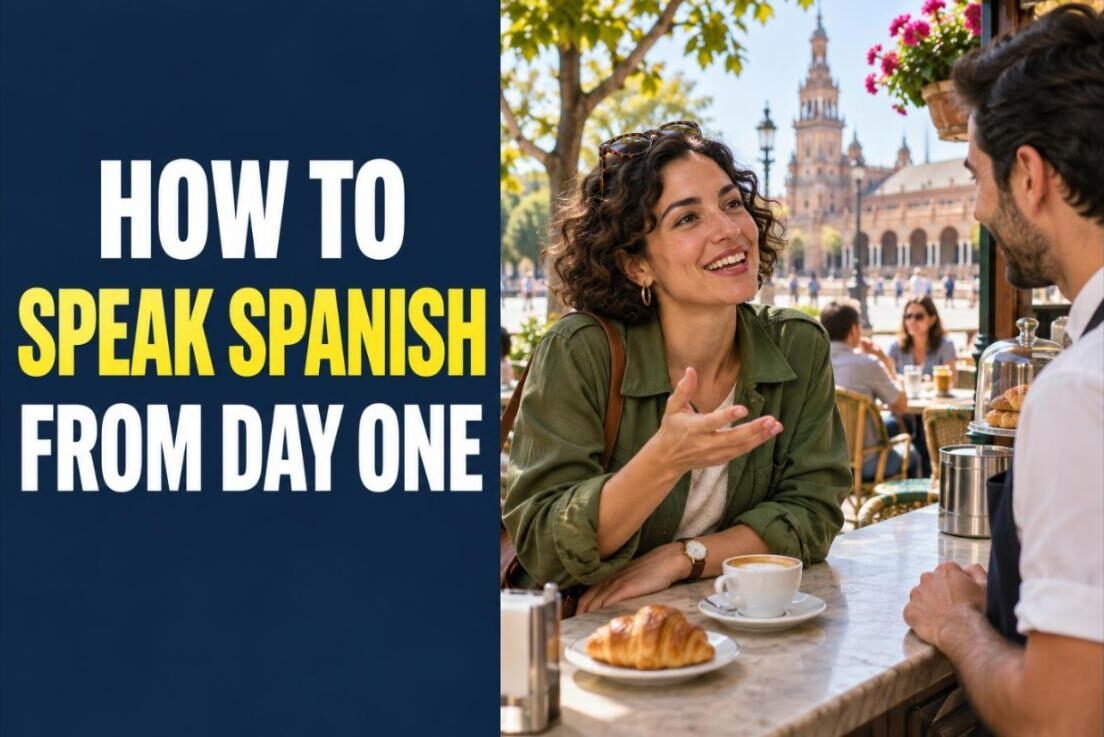
How to Speak Spanish: Start Talking From Day One
This post contains affiliate links. As an Amazon Associate I earn from qualifying purchases, and I may earn a commission on other links, at no extra cost to you. Read the full disclosure.
Most people who “study” Spanish for a year can conjugate a verb on paper and still freeze when a waiter asks what they want. That’s not a talent problem. They practiced reading and tapping, so reading and tapping is what they got good at.
If you want to speak Spanish, you have to speak Spanish. Out loud, badly, starting today. Here’s how to do that without a classroom, a plane ticket, or anyone to talk to.
Five ways to practice speaking, compared
Pick one from this table and start with it this week. You don’t need all five.
| Method | Cost | Best for | The catch |
|---|---|---|---|
| Narrating your day out loud | Free | Day one, zero pressure | Nobody corrects you |
| Shadowing native audio | Free | Accent and rhythm | You repeat sentences, you don’t build your own |
| Language exchange partner | Free | Real back-and-forth conversation | Half the session goes to their English |
| Paid tutor | Per lesson | Fast, direct correction | Costs add up if you go weekly |
| Speaking-first course | One-time or subscription | Structure when you don’t know what to practice | Only works if you actually say the lines out loud |
My take: start with the free two (narrating and shadowing) for the first couple of weeks, then add a human. A tutor is wasted money while you’re still learning to say hello. If you’d rather follow a set program, Better Language Learning is a speaking-first course built around ten-minute daily sessions.
Get the sounds right first
Spanish is kind to beginners here. It has five vowel sounds and they never change. A is always “ah,” E is “eh,” I is “ee,” O is “oh,” U is “oo.” Learn those five and you can pronounce almost any word you see, which is more than English can say for itself.
A few consonants will trip you up. H is silent, so hola is “oh-la.” J sounds like a rough English H, so jugo is “HOO-go.” Double L sounds like a Y in most places, and Ñ is the “ny” in canyon. Then there’s the rolled R, which everybody worries about far too much. People will understand you without it. If you want to work on it anyway, these five-minute pronunciation drills are a good place to start.
Twelve phrases that carry most early conversations
Don’t memorize a vocabulary list. Memorize whole sentences you’ll actually say, and say each one out loud ten times.
| Spanish | English | When you’ll use it |
|---|---|---|
| Hola, ¿qué tal? | Hi, how’s it going? | Every single conversation |
| Me llamo… | My name is… | Meeting anyone |
| Estoy aprendiendo español. | I’m learning Spanish. | Buys you patience instantly |
| ¿Puede repetir más despacio? | Can you repeat that more slowly? | Constantly, at first |
| No entiendo. | I don’t understand. | Also constantly |
| ¿Cómo se dice… en español? | How do you say… in Spanish? | Turns any chat into a free lesson |
| Quisiera un café con leche, por favor. | I’d like a coffee with milk, please. | Cafés and restaurants |
| La cuenta, por favor. | The check, please. | End of the meal |
| ¿Cuánto cuesta? | How much does it cost? | Shops and markets |
| ¿Dónde está el baño? | Where’s the bathroom? | You know when |
| Disculpe. | Excuse me. | Getting someone’s attention |
| Muchas gracias. | Thank you very much. | Everywhere |
Notice the third one. Telling people you’re learning changes the whole exchange. They slow down, they help, and your mistakes stop feeling like failures. For more of the everyday stuff, see these real-life phrases textbooks skip.
If you want these in your pocket, the Lonely Planet Mexican Spanish Phrasebook & Dictionary on Amazon is small enough to travel with. For drilling out loud at home, this Spanish vocabulary flash card set on Amazon does the job.
A 15-minute daily routine
Fifteen minutes every day beats two hours on Sunday. Not close.
Spend the first five minutes shadowing. Play a short clip of slow Spanish, pause after each sentence, and repeat it out loud, copying the rhythm as closely as you can. You’ll feel silly. Do it anyway.
Spend the next five narrating. Describe what you’re doing in the simplest Spanish you’ve got. “Hago café. El café está caliente.” When you hit a word you don’t know, that’s your vocabulary for the day. Look it up, say it three times, move on. There are more solo methods in this guide to practicing without a partner.
Use the last five to record yourself saying yesterday’s phrases, then listen back. It’s uncomfortable and it works, because you’ll hear mistakes you can’t hear while you’re talking.
Stop translating in your head
The freeze happens because you’re building the sentence in English, converting it, and checking the grammar before you open your mouth. By then the conversation has moved on.
The fix is to learn chunks instead of words. You don’t assemble “¿Dónde está el baño?” from four parts. You learned it as one sound, so it comes out as one sound. The more whole sentences you own, the less translating you do. I go deeper on this in three tricks to stop translating in your head.
Three mistakes that will get a laugh
Embarazada doesn’t mean embarrassed. It means pregnant. Announce that you’re “muy embarazada” after tripping on the sidewalk and you’ll get congratulations.
Ser and estar both mean “to be,” and mixing them changes the meaning. “Estoy aburrido” means you’re bored. “Soy aburrido” means you’re a boring person. One of those is a much sadder thing to tell a room.
And años needs its Ñ. “Tengo treinta años” means you’re thirty years old. Drop the squiggle and you’ve said something about anatomy instead. People will know what you meant. They’ll still grin.
None of these are disasters. Mistakes like this are how the words stick, and native speakers are almost always kind about them.
How long until you can hold a conversation?
With fifteen honest minutes a day of speaking practice, most people can get through a simple exchange (ordering, introductions, directions) within a couple of months. Comfortable, unscripted conversation takes much longer, usually well over a year. The full breakdown is in how long it takes to learn a new language. And if you’re wondering where all this will be useful, here’s a map of Spanish-speaking countries.
Frequently asked questions
Can I learn to speak Spanish by myself?
Yes, up to a point. Shadowing, narrating and recording yourself will take you a long way with pronunciation and basic sentences. At some point you’ll need a real person, because nothing else trains you to understand an answer you didn’t expect.
Should I learn Spanish from Spain or Latin America?
Pick the one you’re most likely to use and don’t overthink it. The differences are about the size of British and American English. Speakers from either side will understand you fine.
Do I need to learn grammar before I start speaking?
No. Start speaking with memorized phrases, and learn grammar as questions come up. Grammar makes a lot more sense once you already have sentences in your head to hang it on.
Is Spanish hard for English speakers?
It’s one of the easier ones. The spelling is consistent, thousands of words look like their English cousins, and the sounds are mostly familiar. Verb endings and the ser and estar split take the longest to settle in.
How many words do I need to have a basic conversation?
Fewer than you’d think. A few hundred common words, used inside phrases you’ve practiced out loud, will cover most everyday situations. Knowing 3,000 words you’ve never spoken helps a lot less.