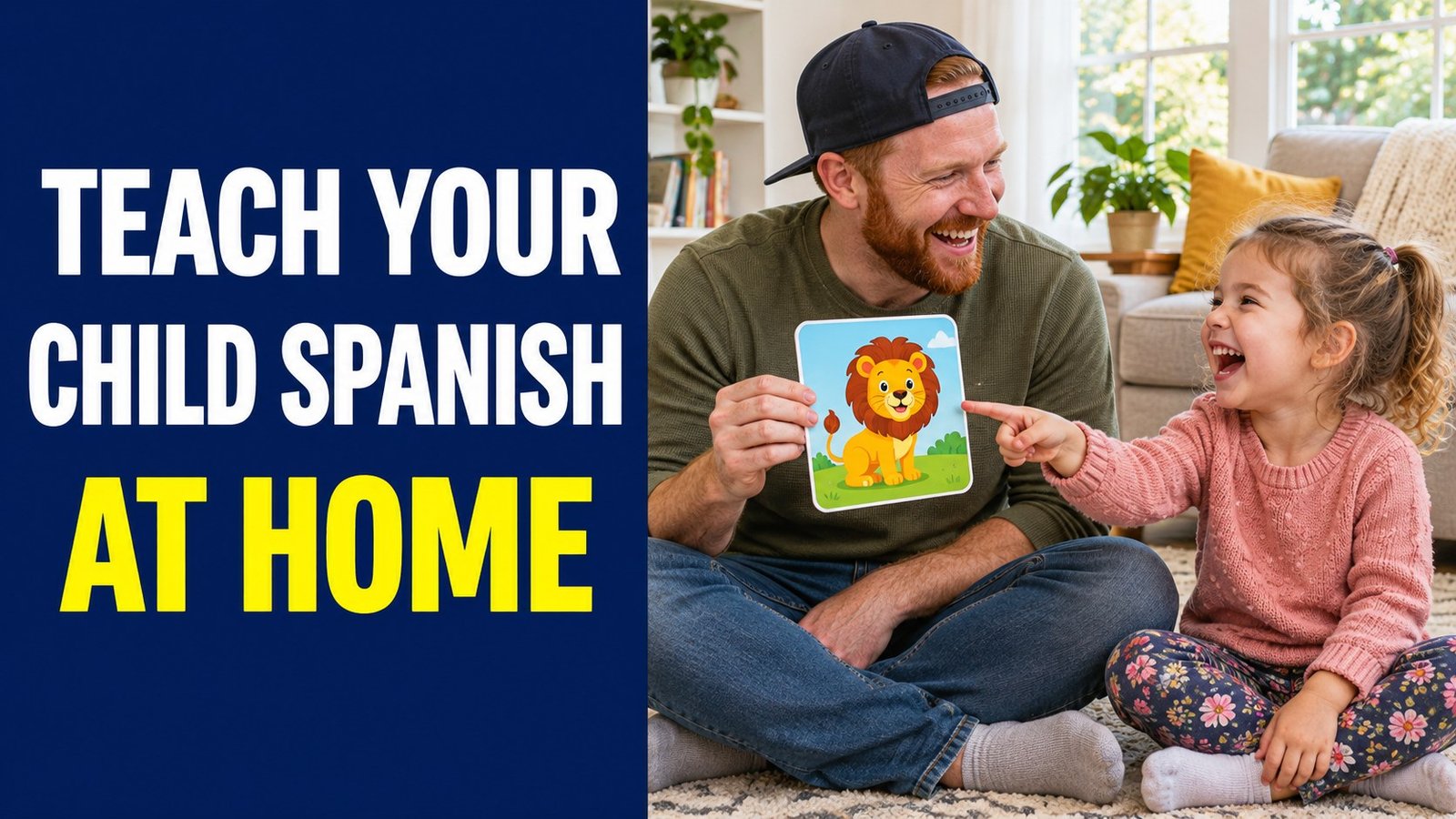
How to Teach Your Child Spanish at Home (Even If You Don’t Speak It)
This post contains affiliate links. As an Amazon Associate I earn from qualifying purchases, and I may earn a commission on other links, at no extra cost to you. Read the full disclosure.
You want your kid to grow up with Spanish. Maybe it’s Grandma’s language. Maybe you just know how much easier it is to learn young. The problem? You don’t really speak it yourself, and the thought of “teaching” it makes you nervous.
Good news: you don’t need to be fluent to teach your child Spanish at home. You need routines, a few good tools, and the willingness to learn right alongside them. Kids are great at picking up sounds. Your job is just to put Spanish in front of them, every day, in a way that feels like play.
Best tools to teach your child Spanish at home: quick comparison
| Tool | Best for ages | What it teaches | Why it works | Where to get it |
|---|---|---|---|---|
| Bilingual board books | 0 to 4 | First words, read-aloud habit | Spanish and English on the same page, so you can read it too | Check price on Amazon |
| First 100 Words bilingual book | 1 to 5 | Everyday nouns | Big pictures, easy to point and name | Check price on Amazon |
| Spanish flash cards with audio | 3 to 8 | Vocab and pronunciation | The audio fixes your accent problem | Check price on Amazon |
| Lotería game | 4 and up | Vocab, listening, family fun | It’s a game, not a lesson | Check price on Amazon |
| Spanish cartoons and songs | Any age | Listening, natural speech | Native voices you can’t provide yet | Free on streaming apps and YouTube |
You don’t have to be fluent (seriously)
Here’s the good news parents raising bilingual kids keep finding: steady exposure matters more than a perfect accent. Kids learn from lots of input, from many sources. You’re one source. Books with audio, songs, cartoons, and other speakers fill in the rest.
What kills it is pressure. Drilling a 4-year-old on vocab lists turns Spanish into homework. Keep it short, fun, and part of normal life.
Start with five daily Spanish moments
Pick a few routines you already do and make them Spanish-only. Five minutes each. That’s it.
| Moment | Spanish to use |
|---|---|
| Breakfast | ¿Quieres leche o agua? (Do you want milk or water?) |
| Getting dressed | Los zapatos, la camisa, los calcetines |
| Bath time | El agua está caliente / fría (the water is hot / cold) |
| Car rides | Colors of cars, counting to 20 |
| Bedtime | A bilingual book, then “Buenas noches, te quiero” |
Learn the phrase yourself the night before. Repetition is your friend here. Kids don’t get bored of the same phrase the way adults do.
1. Bilingual board books (ages 0 to 4)
This is the easiest win. Bilingual books print Spanish and English on the same page, so you can read the Spanish with confidence and check the meaning right there. Little kids want the same book 40 times anyway, which is exactly the repetition language needs.
A boxed set gives you variety without hunting for titles one at a time.
Check price for the Bilingual 10 Board Books in Spanish and English set on Amazon
Classics work too. The bilingual edition of The Very Hungry Caterpillar is a favorite because kids already know the story, so the Spanish slides right in.
Check price for The Very Hungry Caterpillar / La Oruga Muy Hambrienta on Amazon
2. A first-words book (ages 1 to 5)
Picture dictionaries for toddlers are perfect for “point and name” games. You say “¿Dónde está el perro?” and they slap the dog. Big board pages survive toddler hands.
Check price for First 100 Words / Primeras 100 Palabras on Amazon
3. Flash cards with audio (ages 3 to 8)
This one solves the “but my accent is bad” worry. Flash cards that come with online audio let your kid hear a native speaker say each word. You learn the pronunciation right alongside them. Keep sessions to five minutes and turn them into games: hide cards around the room, or race to grab the one you call out.
Check price for Spanish Flash Cards for Kids with audio on Amazon
4. Lotería: the secret weapon
Lotería is a traditional Mexican bingo game with colorful picture cards like el sol, la luna, el corazón, and el gallo. One person calls out the card in Spanish, everyone else marks their board. Kids learn dozens of words without realizing it, and it’s a great way to get grandparents involved. Use dried beans as markers, the way plenty of families do.
Older kids can take turns being the caller, which makes them say the words out loud. That’s the real goal.
Check price for the Don Clemente Lotería game on Amazon
5. Cartoons and music
Switch a favorite show to Spanish audio on your streaming service. Kids already know the plot, so they follow along easily. Spanish-language kids’ songs on YouTube or Spotify are great in the car, too. Don’t worry if you can’t translate everything. Neither can they, and they’ll understand more than you within a few months.
Mistakes that make kids quit
Quizzing them constantly. “How do you say dog?” ten times a day turns Spanish into a test. Use it, don’t test it.
Going all-in, then stopping. Two weeks of intense Spanish followed by nothing doesn’t stick. Five minutes every single day beats an hour on Saturday.
Correcting every mistake. If your kid says “yo es grande,” just repeat it back correctly: “¡Sí, tú eres grande!” They’ll pick it up.
Learn alongside them
Kids who see their parents learning take it more seriously. If you want to build your own Spanish at the same pace, try learning Spanish while driving on your commute, and keep a short daily habit with these tips for learning a language quickly. Start with basics like numbers and colors, which are exactly what little kids want to talk about.
Frequently asked questions
Can I teach my child Spanish if I don’t speak it?
Yes. Use bilingual books, audio flash cards, songs, and cartoons for native input, and learn the everyday phrases alongside your child.
What age is best to start teaching kids Spanish?
As early as you like. Babies and toddlers soak up sounds, but kids of any age can learn with consistent, playful exposure.
How much Spanish should my child hear each day?
Even 15 to 30 minutes of daily exposure through routines, books, and songs makes a difference. Consistency matters more than length.
Will learning Spanish confuse my child’s English?
Mixing languages for a while is normal for bilingual kids and usually sorts itself out. If you have concerns about speech development, check with your pediatrician.
What is Lotería?
A traditional Mexican bingo-style game with illustrated picture cards. It’s a fun way for kids to learn Spanish vocabulary.