How to Understand Fast Spanish Speakers (When It All Sounds Like One Long Word)
This post contains affiliate links. As an Amazon Associate I earn from qualifying purchases, and I may earn a commission on other links, at no extra cost to you. Read the full disclosure.
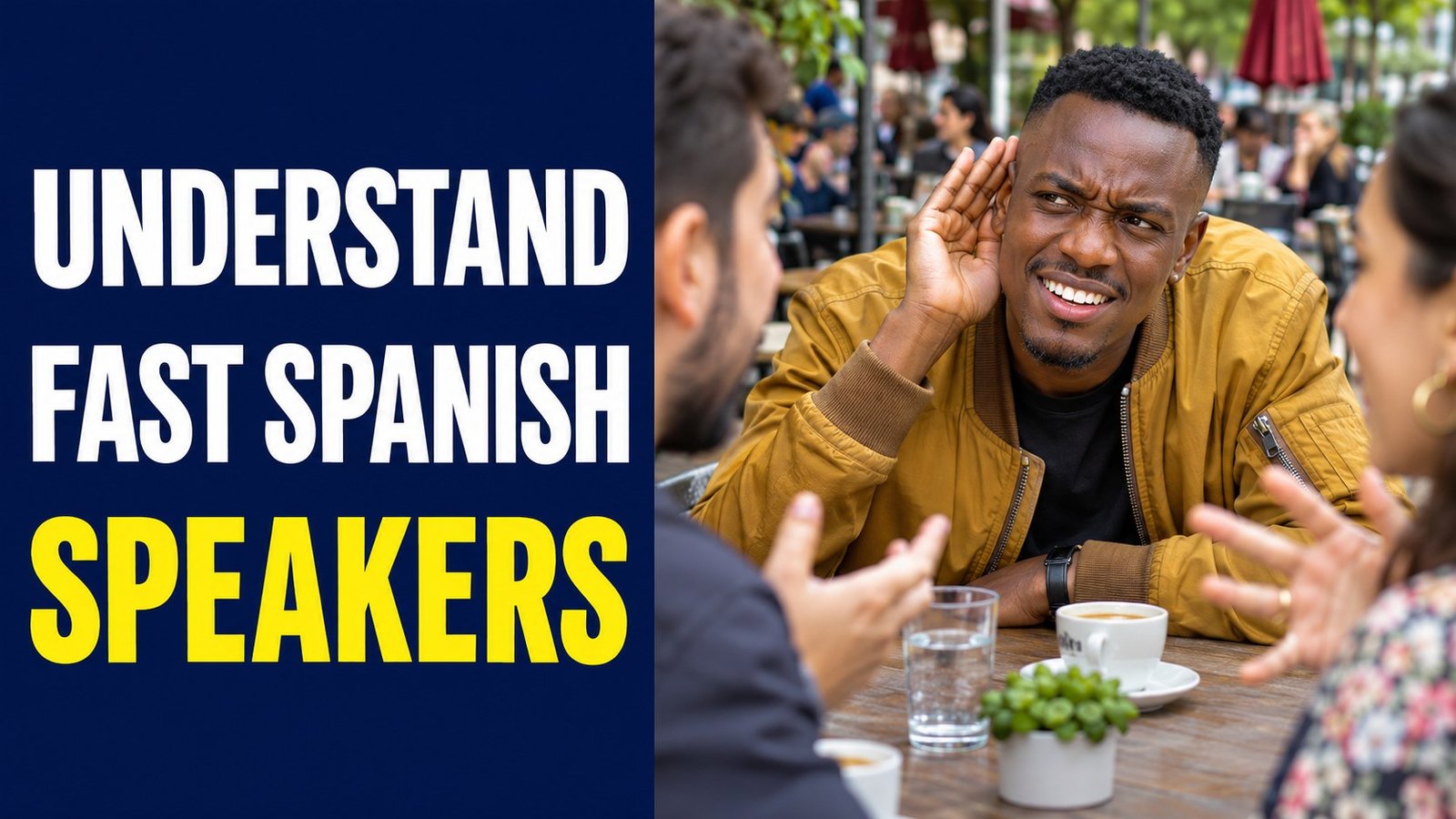
You can read Spanish. You understand your teacher, your app, maybe even a slow podcast. Then a real person starts talking at normal speed and it’s just… noise. One long word with no gaps. You catch “pero” and “entonces” and nothing else.
This is one of the most frustrating walls in learning Spanish, and almost everyone hits it. It isn’t a sign you’re bad at languages. It’s a specific skill you haven’t trained yet. Here’s why fast Spanish sounds impossible, and exactly how to fix it.
Fixes for understanding fast Spanish: quick comparison
| Fix | How long it takes | Cost | What it solves | Where to get it |
|---|---|---|---|---|
| Graded stories with audio | A few weeks | Low | Builds listening at the right level | Check price on Amazon |
| Slow it down, then speed it up | Daily, 10 minutes | Free | Trains your ear to hear word gaps | Free in any audio player |
| Shadowing | Daily, 5 to 10 minutes | Free | Teaches the rhythm natives use | Free |
| Learn the sound shortcuts | One afternoon | Free | Explains why words “disappear” | Free (see the table below) |
| Audio courses that make you respond | A few months | Paid | Faster processing under pressure | Check price on Amazon |
Why native Spanish sounds so fast
Spanish isn’t actually spoken faster than English in any way that matters to you. But it feels faster, for a few concrete reasons.
Words glue together. When one word ends in a vowel and the next starts with one, Spanish speakers blend them. “Me voy a ir a la casa” comes out sounding like “me-vo-ya-i-ra-la-ca-sa.” Your brain is hunting for spaces that aren’t there.
Sounds get dropped. In casual speech, “para” becomes “pa’,” “está” becomes “‘tá,” and in much of Spain and the Caribbean, “cansado” turns into “cansao.” Textbooks never warn you.
Your brain is still translating. If you hear “perro,” think “dog,” then try to keep up, you’re already three words behind. The goal is to understand Spanish as Spanish. Our post on how to stop translating in your head goes deeper on this.
Missing vocabulary. Sometimes it’s not the speed. It’s that one unknown word in the middle derails the whole sentence while your brain tries to figure it out.
Fix 1: Listen at your level, a lot
Most people try to fix this by listening to native TV and hoping. That’s like learning to swim by jumping in the ocean. You need audio that’s just a little above your level, where you understand most of it and stretch for the rest.
Graded readers are perfect for this. You read a short story, listen to it, then listen again without the text. Repeat until the audio sounds clear. The Short Stories in Spanish series by Olly Richards is built exactly for this, with glossaries and comprehension checks after each chapter. Check the listing for the audio that comes with the edition you choose.
Check price for Short Stories in Spanish for Beginners on Amazon
If the beginner stories feel easy, jump to the intermediate book. The stories get longer and more natural, which is exactly the bridge you need toward real conversation.
Check price for Short Stories in Spanish for Intermediate Learners on Amazon
Fix 2: Slow it down, then speed it back up
YouTube, podcast apps, and most players let you slow audio to 0.75x. Do this with a short clip, under two minutes, ideally one with a transcript or subtitles.
| Pass | Speed | What to do |
|---|---|---|
| 1 | 0.75x with transcript | Read along, look up unknown words |
| 2 | 0.75x without transcript | Notice where words connect |
| 3 | 1x with transcript | Catch the blended sounds |
| 4 | 1x without transcript | Understand it cold |
By pass four, the “noise” turns into words. Do this with one clip a day and your ear adjusts surprisingly fast. The same clip, four times, beats four different clips once each.
Fix 3: Shadowing
Shadowing means repeating audio out loud, a half second behind the speaker, copying their rhythm and melody. It feels silly. It also works. Once your mouth can produce the blended, fast version of a sentence, your ear starts recognizing it too.
Start with short sentences from your graded reader audio. Pause, repeat, play again. Our 5-minute pronunciation drills pair well with this.
Fix 4: Learn the shortcuts natives use
| You hear | Full form | Meaning |
|---|---|---|
| pa’ | para | for, to |
| ‘tá bien | está bien | it’s fine |
| cansao | cansado | tired (Spain, Caribbean) |
| ‘pérate | espérate | wait |
| pos | pues | well, so (Mexico) |
| na’ | nada | nothing |
Once you know these exist, you stop panicking when a word sounds “wrong.” A few minutes reviewing them saves a lot of confusion. For more of these, see real-life phrases textbooks don’t teach.
Fix 5: Practice responding under pressure
Understanding in real life means processing while someone waits for your answer. Audio courses that ask you to reply quickly train exactly that. Pimsleur does this well, and it’s easy to fit into a commute. Our guide to learning Spanish while driving shows how.
Check price for Pimsleur Spanish Conversational Course Level 1 on Amazon
What to say when you’re lost in a real conversation
Even with practice, you’ll get lost sometimes. Natives do too. Keep these ready: “¿Puede hablar más despacio, por favor?” (can you speak slower, please?), “¿Cómo?” (sorry, what?), and “No entendí la última parte” (I didn’t catch the last part). Most people are happy to slow down. Asking is a sign you’re trying, not failing.
Frequently asked questions
Why can I understand Spanish but not native speakers?
Native speakers blend words together, drop sounds, and use slang. Learner materials don’t, so your ear hasn’t been trained for real speech yet.
How long does it take to understand fast Spanish?
With daily focused listening, most learners notice a big difference in a few weeks and keep improving over several months.
Is it better to listen with or without subtitles?
Both. Use Spanish subtitles or a transcript first to learn the words, then listen again without them to train your ear.
Does slowing down audio actually help?
Yes, as a step. Listen slowed down first, then at normal speed. The goal is always to finish at 1x.
What is shadowing in language learning?
Repeating audio out loud right after the speaker, copying their rhythm and pronunciation. It helps both speaking and listening.